
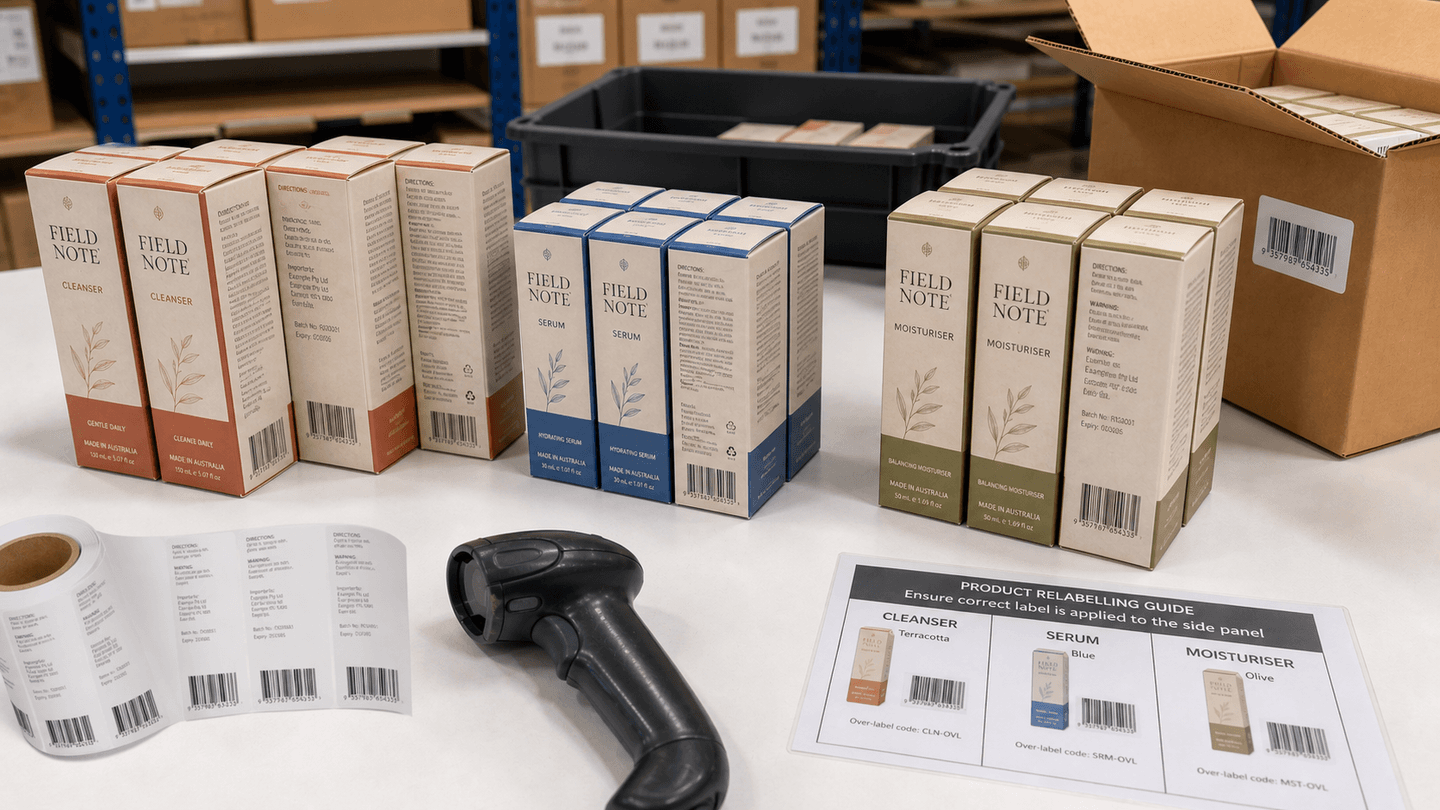
Relabelling starts with an approved correction
Product relabelling or repacking is the right response when saleable stock can be brought back into an approved condition without changing the product itself. The physical work may involve label-over application, label removal and replacement, barcode correction, supplementary information, new inserts or a complete secondary-pack change.
The decision to rework stock must come before production starts. The brand owner, sponsor or regulatory adviser defines the approved correction, affected stock and release conditions. A production provider then applies that instruction consistently, records exceptions and returns evidence that the work matched the brief. If the compliant label content is still being decided, the job is not ready for the production floor.
This operating guide begins where our product labelling compliance guide ends. That article helps brands understand which rules may apply. This one explains how to control the physical recovery work after the correction has been approved.
When relabelling or repacking is the right response
Relabelling is most useful when the stock remains physically sound and the problem can be corrected through approved packaging information or presentation. Repacking becomes appropriate when the pack format itself is damaged, obsolete or unsuitable for the intended market.
- Market-entry correction. Imported stock needs approved local information, warnings, language, distributor details or identifiers before release.
- Regulatory or artwork change. Existing stock carries a superseded label and the responsible product owner has approved a correction path.
- Retailer requirement. Barcodes, tickets, pack configuration or shelf-ready presentation must change for a specific channel.
- Recall or market action. A regulator-approved strategy allows affected stock to be corrected and returned to supply rather than destroyed.
- Packaging recovery. The product is suitable for sale but cartons, inserts, labels or secondary packs need replacement after damage or a specification change.
Decide the disposition before touching stock
A controlled rework job starts with a written disposition: release without change, inspect, segregate, relabel, repack, quarantine, return or destroy. That decision must identify who can approve the correction and who can release the finished stock. Production teams should not infer either from an email thread or an outdated artwork file. For Australian therapeutic goods, the TGA's current Procedure for recalls, product alerts and product corrections uses a five-step market-action process, reduced from the previous 10 steps. Its published timeframes include a target of seven business days for agreeing to a complete notification and automatic publication to the DRAC two business days after agreement. Immediate-risk situations follow a different path and can require the sponsor to contact the TGA promptly within 48 hours. The figures below are regulatory process points, not a production timetable. The TGA can vary requirements case by case and incomplete material can delay review. For other product categories and countries, the decision path will differ. The same production principle still holds: define the affected batches, approved artwork, correction method, inspection rule and release authority before stock moves out of quarantine.
| TGA process point | Published figure | What it means operationally |
|---|---|---|
| PRAC process | 5 steps, reduced from 10 | Assessment, notification, initiation and closeout should be planned as one controlled process |
| Immediate-risk notification | Contact the TGA promptly within 48 hours | Urgent quarantine and customer protection may begin before the standard review path |
| TGA review target | Within 7 business days for complete notifications | Incomplete or unclear evidence can extend the approval window |
| DRAC publication | 2 business days after agreement | Summary details become publicly searchable shortly after the action is agreed |
| Progress reporting | Typically 6 weeks and 12 weeks | Production records and reconciliations must support interim and closeout reporting |
Build a rework brief that cannot be misread
A good brief removes judgement from the application bench. It tells each person what stock is in scope, what correct looks like and what must happen when something does not match.
- Stock scope. Record SKUs, batches, lot numbers, serial ranges, quantities and current locations.
- Approved source files. Identify the artwork version, approval date and owner. Withdraw superseded files from the production pack.
- Application standard. Show exact placement, orientation, overlap, legibility, adhesion and acceptable finish using approved reference images.
- Product matching. Define how workers distinguish similar SKUs, markets, flavours, sizes or pack variants before applying a label.
- Barcode and identifier checks. Confirm the approved data and whether the proposed change affects the trade item identifier under the GS1 GTIN Management Standard.
- Inspection rule. State whether every unit needs verification or whether an approved sampling plan applies. Define who can accept an exception.
- Handling controls. Include storage, hygiene, security, temperature, breakage and segregation requirements relevant to the product.
- Release evidence. Specify the counts, photographs, scan results, reconciliation and approvals required before dispatch.
Choose the correction method deliberately
The fastest method is not always the safest one. The right choice depends on the approved disposition, pack surface, label position, product category and evidence required at release.
| Correction method | Best fit | Main control point |
|---|---|---|
| Label-over application | The existing label may remain and the approved correction can fully cover the relevant content | Opacity, adhesion, placement and continued readability of information that must remain visible |
| Remove and replace | The old label must not remain or the finished presentation requires a clean surface | Product or pack damage during removal, residue control and correct replacement variant |
| Supplementary label | Approved information can be added without changing the main label | The new label must not obscure required information or create conflicting instructions |
| Barcode or ticket correction | The product data or retail channel requires a new approved identifier or ticket | Scan verification against the product master and destination allocation |
| Secondary repack | The product is suitable but the carton, insert, bundle or presentation pack must change | Component completeness, product protection, pack version and final configuration |
Run the work in controlled batches
Production should move through a repeatable sequence: receive and quarantine the stock, reconcile it to the approved scope, set up one confirmed reference unit, apply the correction, verify the output, isolate exceptions and reconcile finished quantities before release. A controlled relabelling workflow makes each handoff visible instead of relying on a final inspection to catch everything.
The highest risk is usually variant confusion. Similar packs may need different labels for market, SKU, batch or product version. Separate work zones, one active artwork version, visible reference units and clear changeover rules reduce that risk. Verification should check both the physical finish and the match between product, label and destination.
A published CleverPak wine relabelling case study records 80,000 bottles across 12 label variants corrected in 48 hours using two facilities and more than 25 workers. Each bottle moved through four controlled stages: depalletising, label replacement, quality verification and repalletising. Those figures describe one urgent project, not a standard lead-time promise. The lesson is that speed came from clearer controls and parallel capacity, not from removing inspection steps.
Regulated products need an extra licence check
For regulated products, confirm whether the proposed work is itself a regulated manufacturing step and whether the chosen facility is authorised for that exact activity. Do this before transport is booked.
In Australia, the TGA states that manufacture of medicines and other therapeutic goods can include packaging and labelling. For listed medicines, its licensing decision guidance identifies packaging and labelling as mandatory manufacturing steps and places responsibility on the sponsor to use manufacturers with the appropriate licence or clearance. Medical devices follow a different manufacturer and conformity-assessment framework, so a medicine licence should not be treated as a general medical-device approval.
Australia's medical-device Unique Device Identification requirements are also being phased in. The TGA confirms that UDI labelling became mandatory for Class III and Class IIb devices on 1 July 2026, with later dates for other device classes. Its UDI guidance explains the applicable dates and the responsibility to maintain device data in the AusUDID.
These examples show why a production provider should not decide regulatory content. The sponsor, manufacturer or qualified adviser confirms the obligation and approved correction. The provider confirms that its facility, process and records can execute that instruction. This article is operational guidance, not regulatory or legal advice.
What evidence should return with the stock
A completed quantity is not enough. The release pack should let the brand owner confirm what was received, what was changed, what passed inspection and what happened to every exception.
| Evidence | What it should confirm | Why it matters |
|---|---|---|
| Inbound reconciliation | Received quantity by SKU, batch, lot or serial range | Establishes the controlled population before work begins |
| Artwork and instruction record | The approved version used for the production run | Prevents superseded labels or instructions being used |
| Inspection record | Checks completed, results, exceptions and corrective action | Shows whether the finished stock met the agreed standard |
| Quantity reconciliation | Good units, rejected units, damaged units and unused labels | Closes gaps that could hide a mix-up or stock loss |
| Release approval | The authorised person who accepted the finished output | Separates production completion from regulatory or commercial release |
| Dispatch evidence | Destination, quantity, date and stock identity | Maintains traceability as corrected stock returns to distribution |
When CleverPak fits the job
CleverPak manages the physical production work around relabelling and repacking: stock reconciliation, approved work instructions, facility matching, controlled application, quality checkpoints and output evidence. CleverPak Connect gives the brand one view of progress and exceptions when work needs to run across more than one facility or location.
The facilities performing that work are part of the CleverPak Team. The same production creates meaningful employment for people who face barriers to steady work, while the customer receives a managed correction rather than a set of disconnected labour and warehouse tasks.
CleverPak is best suited to established stock with approved artwork, a defined correction and a clear release authority. If those inputs are ready, discuss the relabelling requirement with the CleverPak Team.