
What a Product Recall Actually Involves
A product recall is the coordinated removal of a product from the market because it presents a safety, quality or compliance risk to consumers. As of 2026, every major market operates a comparable recall framework: the FDA in the US, the TGA in Australia, the MHRA in the UK, FSANZ in Australia and New Zealand, HSA in Singapore, and the EMA across the European Union. The categories differ in name but the obligations are consistent: notify, contain, rework or destroy, document.
The recall itself is only half the work. The harder half is what happens to the affected stock: rework, relabeling, repackaging, segregation, audit-grade record-keeping, and in many cases secure destruction. That execution layer is where most recalls fail. Planning systems can identify what needs to be recalled within minutes. Physically processing hundreds of thousands of units inside a regulator-mandated deadline is a different problem entirely.
This guide walks through how recalls are classified, what the first 72 hours look like, where recalls typically go wrong, and how to evaluate a rework and destruction partner before you need one.
Recall Classifications and Regulators
Not all recalls are equal. The regulator who owns the recall, and the urgency they impose, depends on the product category and the level of risk to consumers.
Most national regulators use a three-tier classification system that maps closely across jurisdictions. The FDA, TGA, MHRA, FSANZ and HSA all use Class I, II and III (or equivalent severity tiers), so the same response logic applies whether your recall is single-market or global.
Class I is the most serious. There is a reasonable probability that use of the product will cause serious adverse health consequences or death. Examples: undeclared major allergens in food, pharmaceutical contamination, electrical safety defects in consumer goods. Action is required within 24 to 72 hours.
Class II covers products that may cause temporary or medically reversible adverse health consequences, or where the probability of serious harm is remote. Examples: minor labelling errors on therapeutic goods, sub-potent supplements, packaging defects that compromise sterility. Action is typically required within 7 to 14 days.
Class III covers products unlikely to cause adverse health consequences but that breach regulatory or quality standards. Examples: incorrect country-of-origin labels, missing ingredient declarations on cosmetics, non-compliant retail-ready packaging. Action is typically required within 30 days.
Recall Classifications at a Glance
Use this as a quick reference. Confirm specific timelines with your regulator for any active recall.
| Classification | Risk Level | Typical Regulator | Action Window | Typical Response |
|---|---|---|---|---|
| Class I | Life-threatening or serious harm | TGA, FSANZ, FDA, ACCC | 24 to 72 hours | Full market withdrawal, destruction, public alert |
| Class II | Temporary or reversible harm | TGA, FSANZ, MHRA | 7 to 14 days | Withdrawal and rework, or controlled destruction |
| Class III | Compliance breach, low health risk | TGA, FSANZ, ACCC, HSA | Up to 30 days | Relabel, repack or correct in place |
| Field Safety Notice | Medical device correction | TGA, FDA, MHRA | Per risk assessment | Customer notification and correction |
| Voluntary withdrawal | Brand-initiated quality concern | Self-managed | Brand-determined | Quiet rework or destruction, no public notice |
The First 72 Hours: What Actually Happens
The first three days of a recall are decisive. Decisions made in this window determine whether the recall costs hundreds of thousands or tens of millions, and whether the brand recovers cleanly or carries reputational damage for years.
Hours 0 to 6: confirm and notify. Confirm the issue is reproducible, identify affected batch and lot codes through your traceability system, and notify every regulator that has jurisdiction over the affected markets. For therapeutic goods, that is typically the FDA, TGA, MHRA or equivalent. For food, FSANZ, the FDA, the FSA in the UK, or local health authorities. For general consumer goods, the CPSC in the US, the ACCC in Australia, or the OPSS in the UK. Failing to notify within the regulator's required window is itself a breach.
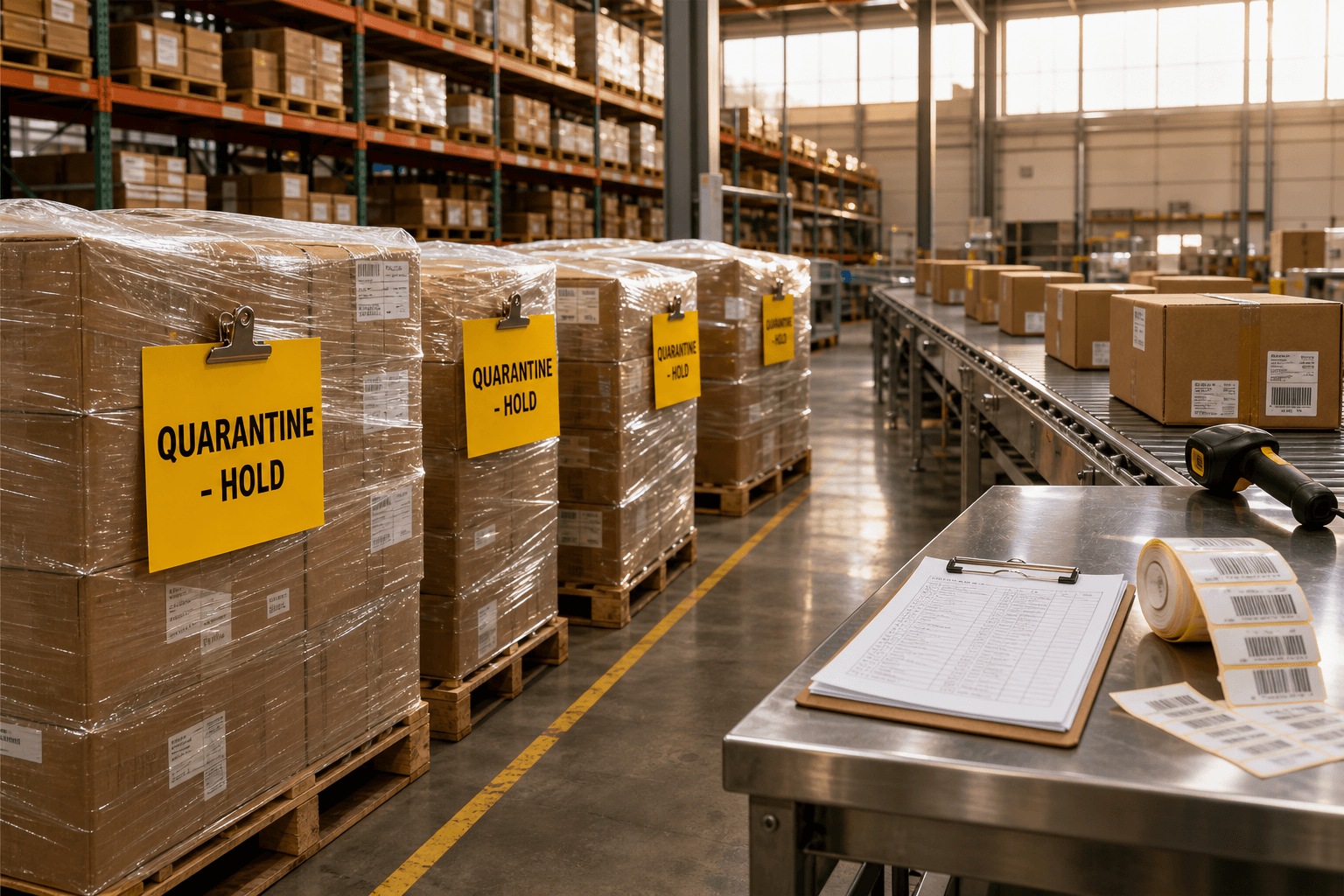
Hours 6 to 24: contain. Issue a stock hold to retailers, distributors and warehouses. Quarantine all affected stock in your own facility and any contract packing or 3PL site holding the product. Pull the GS1 batch and SSCC records so every pallet can be traced. This is also the point at which you need to decide who is doing the rework, because the answer changes the next 48 hours significantly.
Hours 24 to 72: mobilise execution. Depending on the classification, this is when product moves to a rework facility for relabeling, compliance corrections, or secure destruction. A Class I recall typically requires destruction with full audit-grade certification. A Class III recall may only require relabeling or insert replacement. Either way, the facility doing the work needs to be able to absorb the volume immediately, not in two weeks when their schedule clears.
Where Recalls Actually Fail
In our experience working across food, pharmaceutical, cosmetics and consumer goods recalls, the failure points are rarely in the planning. They are in the execution layer. The four most common failure modes:
- No fallback capacity. The brand's existing co-packer is either at capacity, conflicted (they were involved in the original error), or geographically distant from where the affected stock is sitting. Sourcing emergency capacity under a 72-hour deadline rarely ends well.
- Audit-grade documentation gaps. Regulators require evidence that 100% of affected units were recovered, processed and either reworked or destroyed. Spreadsheet tracking and email confirmations are not sufficient. A unit-level audit trail with photographs, batch reconciliation and destruction certificates is the minimum standard for TGA and FDA-regulated recalls.
- Slow ramp-up. A facility can quote 200,000 units per week, but if it takes them five days to staff up, the deadline is already missed. The relevant metric is hours-to-first-output, not theoretical weekly throughput.
- Destruction certification weakness. For Class I recalls, regulators require evidence that destroyed product cannot re-enter the supply chain. A facility that ships destruction to a third party without chain-of-custody documentation creates audit risk the brand carries.
What a Recall Actually Costs
Recall costs vary widely based on classification, volume and how the response is structured. The figures below reflect typical international market ranges in 2026 (in USD) for a mid-sized recall (50,000 to 500,000 units). Local market rates vary, but the proportions between line items hold across regions.
Direct recall costs typically range from USD $30,000 for a small Class III labelling correction to over USD $10 million for a market-wide Class I recall in a regulated category. The breakdown varies, but the major line items are consistent.
Per-unit rework rates typically fall between USD $0.10 and $0.85 per unit depending on complexity. A simple relabel over an existing label runs at the lower end. A full repack, including insert replacement, blister card swap or secondary packaging change, runs at the higher end. Compliance corrections requiring sleeve removal, sterile handling or temperature-controlled environments are priced separately and can run significantly higher.
Destruction costs for products that cannot be reworked typically run USD $0.04 to $0.30 per unit for general waste streams, and USD $0.35 to $2.00 per unit for regulated waste streams including pharmaceuticals, hazardous materials and devices requiring data destruction. Witnessed destruction with full audit documentation typically adds 15 to 25 percent.
Indirect costs are usually larger than direct costs. Lost sales during the recall window, retailer charge-backs (Tier 1 grocery retailers including Walmart, Tesco, Carrefour, Woolworths and Coles typically apply administrative penalties per affected SKU), expedited freight to consolidate affected stock, and reputational damage are all real numbers that should be factored into the response decision.
Choosing a Rework and Destruction Partner
The time to evaluate a recall execution partner is before a recall, not during one. The brands that recover cleanly almost always have a pre-qualified partner identified, sometimes with a standing agreement in place. The brands that take the worst hits are the ones searching for capacity at 11pm on day one. Five things to verify when evaluating a partner:
- Hours-to-first-output, not weekly throughput. Ask how quickly they can mobilise a dedicated line on a Class I recall. A credible partner can be running within 24 to 48 hours for typical volumes. If they need a week, they are not a recall partner.
- Network depth. A single facility is a single point of failure. A network of facilities can absorb a 500,000-unit recall by parallelising across multiple sites, which is often the difference between a 5-day response and a 15-day response. CleverPak operates across 160+ facilities and routinely splits high-volume recall work across three to five sites to compress the timeline.
- Audit-grade record-keeping by default. Unit-level photographs, batch reconciliation, destruction certificates and an immutable platform audit log should be standard, not an upgrade. For product labeling compliance corrections, the facility should be able to provide a full chain-of-custody trail from receipt to dispatch.
- Regulatory experience. TGA-regulated rework requires GMP-aware handling, controlled environment access where applicable, and operators briefed on the regulatory context. Food rework requires HACCP-certified facilities. Cosmetics and personal care rework requires understanding of ingredient and labelling requirements across markets. Ask for examples of recalls they have run in your category.
- Destruction chain-of-custody. For regulated destruction, the facility should hold appropriate licensing or partner with a licensed destruction operator under a documented chain-of-custody agreement. Witnessed destruction with photo and video evidence should be available on request.
Preparing Before You Need It
The single most useful preparation activity is a mock recall. Run a simulated Class II recall through your existing supply chain at least annually. Time how long it takes to identify all affected batches, contact retailers, mobilise rework capacity and complete the response. Most brands discover their actual recall response time is two to three times longer than their plan assumes. A short readiness checklist:
- Traceability system reviewed. Can you identify every unit of a given batch, including which retailers and distributors received them, within one hour? If not, fix this first.
- Pre-qualified rework partner identified. Have a partner you have visited, evaluated and ideally already worked with on a non-recall job. The trust is built before the pressure, not during it.
- Standing agreement or framework contract. Some brands run a small ongoing volume of routine rework or compliance corrections with their nominated partner specifically to maintain a live commercial relationship that can be scaled instantly.
- Internal recall team and decision matrix. Who makes the destroy-vs-rework call? Who notifies the regulator? Who briefs retailers? Document this before you need it.
- Mock recall annually. Schedule it. Run it. Find the gaps. Fix them.
- Insurance and indemnity reviewed. Recall insurance is widely available and increasingly required by Tier 1 retailers. Verify what your policy covers and what it requires you to do to maintain cover.
How CleverPak Handles Recall Work
CleverPak's network is built for exactly the kind of surge capacity a recall demands. We routinely run rapid response recall and rework jobs across food, pharmaceuticals, cosmetics and consumer goods, and the model is straightforward: one commercial relationship, multiple facilities mobilised in parallel, full audit-grade documentation through CleverPak Connect, and a chain-of-custody for destruction that holds up to regulator scrutiny.
For enterprise customers, we maintain pre-qualified recall response arrangements so the activation conversation on day one is a phone call, not a credit application. Recalls are exactly the kind of execution problem CleverPak exists to solve. Our network of facilities, anchored by a workforce that is meticulous, instruction-driven and built for compliance-heavy work, is designed to move from cold to running on a dedicated line within the first one to two business days.
Frequently Asked Questions
How long do we have to act on a Class I product recall?
For Class I recalls, regulators including the FDA (US), TGA (Australia), MHRA (UK), FSANZ (Australia and New Zealand) and HSA (Singapore) all expect immediate action: notification within 24 hours of identifying the issue, and physical containment of affected stock within 24 to 72 hours. Failing to act within these windows is itself a regulatory breach and can trigger enforcement action beyond the recall itself. The exact timeline is set by the regulator on a case-by-case basis, but planning for a 24-hour mobilisation is the safe assumption in any market.
Can we rework recalled product rather than destroy it?
It depends on the classification and the issue. Most Class III recalls can be reworked: relabelled, repacked or corrected in place. Many Class II recalls can also be reworked if the underlying issue is correctable, for example a missing allergen statement that can be added through a corrective label. Class I recalls involving contamination, sterility breach or product safety issues almost always require destruction. The decision needs to be made jointly with the regulator and documented as part of the recall response.
How much does a product recall cost in 2026?
Direct recall costs in 2026 typically range from USD $30,000 for a small Class III labelling correction to over USD $10 million for a market-wide Class I recall in a regulated category. Per-unit rework rates run USD $0.10 to $0.85 depending on complexity. Destruction runs USD $0.04 to $2.00 per unit depending on whether the product is general waste or regulated waste. Indirect costs, including lost sales, retailer charge-backs and reputational damage, are typically larger than the direct costs. Figures vary by region but the proportions hold.
Do we need a separate facility for recall rework, or can our existing co-packer do it?
It depends on three things: capacity, conflict and location. If the recall stems from an error at your existing co-packer, you generally cannot use the same site for the rework, both for impartiality and because their process is the issue under review. If they are at capacity with other work, mobilising a dedicated recall line is unlikely within the timeframe. And if the affected stock is sitting in multiple retailer distribution centres or 3PL sites, a network with facilities near each location moves faster than a single site. Most brands managing recalls well use a separate, pre-qualified partner.
What documentation do regulators expect from rework and destruction?
For FDA, TGA, MHRA, FSANZ and HSA-regulated products, regulators expect unit-level reconciliation showing 100% of affected units accounted for, batch-level records linking original production to rework or destruction, photographic evidence of the rework or destruction, and a destruction certificate from a licensed operator where applicable. Chain-of-custody documentation from quarantine to final disposition is the minimum standard across every major market. CleverPak Connect maintains this audit trail automatically for every recall job we run.
How quickly can CleverPak mobilise a recall response?
For pre-qualified customers with a standing arrangement, we aim to have a dedicated line running within one to two business days of activation. For new customers, mobilisation typically takes two to four business days depending on volume, location and complexity. The first call should be to confirm capacity, location and audit requirements. Credit and contracting can be completed in parallel with mobilisation rather than blocking it.
Should we run a mock recall, and how often?
Yes. A mock recall at least annually is now standard practice for any brand handling regulated products, and is increasingly expected by Tier 1 retailers including Walmart, Tesco, Carrefour, Woolworths and Coles as part of their supplier compliance programs. A mock recall typically takes a week to organise and a day to run, and almost always surfaces gaps in traceability, communication or capacity that would be expensive to discover during a real recall.