
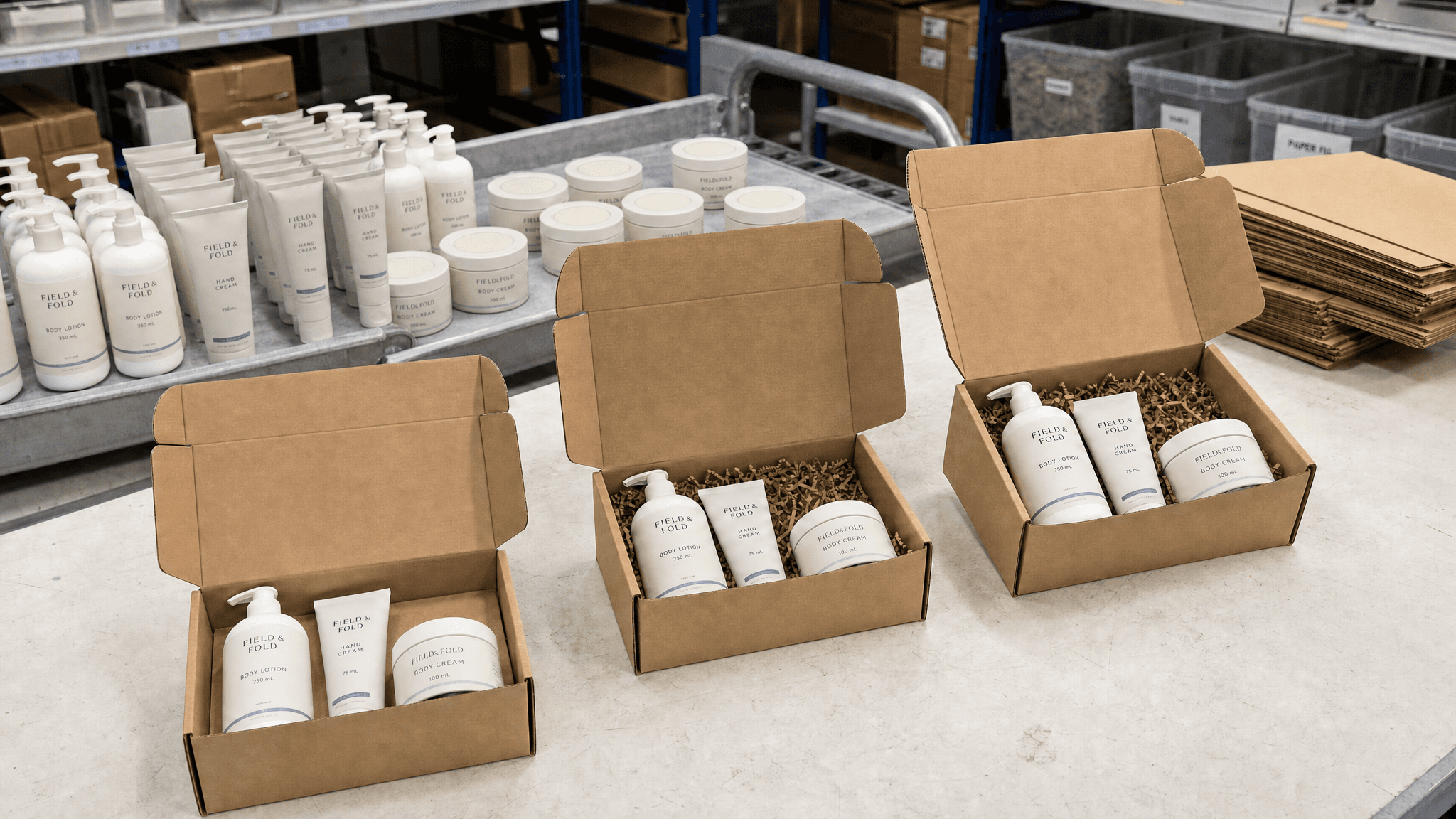
Start with the finished kit
A useful assembly and kitting brief describes what goes into each finished unit, how it should look, how many are required and when they must arrive. It also identifies who supplies each component, who approves the result and what happens if something is missing or damaged.
You do not need every answer before starting a conversation. Send what you know and mark the gaps. The purpose of the brief is to turn those gaps into decisions before they affect a quote, a production run or a delivery.
For a gift set, promotional pack or multi-part product, begin with a photograph, drawing or sample of the intended finished unit. State whether it is an early concept or an approved reference. A photograph can show presentation, but it cannot confirm an unseen component, a quantity or permission to begin production.
Put the key information in one brief
Give the brief a version and date, and nominate one contact who can resolve questions. Use the following fields as a starting template. Keep unknown details visible rather than filling them with assumptions.
| Brief field | What to supply |
|---|---|
| Finished unit | Product or kit name, reference image and the intended use or sales channel. |
| Components | Item code, description, quantity per kit and any permitted variants. |
| Order quantity | Finished kits required, split by variant and destination. |
| Materials | Who supplies products, boxes, inserts, labels and outer cartons, with expected arrival dates. |
| Assembly method | Order of assembly, orientation, folds, closures and handling requirements. |
| Quality and approval | Acceptable presentation, inspection requirements, approval owner and exact approval type. |
| Dispatch | Units per carton, carton and pallet requirements, delivery address and required arrival date. |
| Exceptions | Who decides on shortages, damaged stock, substitutions and changes to the brief. |
Count components against finished output
List every component that is consumed by the job, including packaging. A bill of materials is simply that list with the quantity needed for one finished kit. Multiply it by the required output, then agree any additional stock needed for samples, setup or damage separately.
For example, an order for 5,000 kits containing one bottle, two sachets and one leaflet needs 5,000 bottles, 10,000 sachets and 5,000 leaflets. It also needs 5,000 boxes and 5,000 inserts if each kit uses one of each. These are base requirements before any agreed allowance.
If only 9,600 usable sachets arrive, they support 4,800 complete kits at two sachets per kit. The shortfall is 200 kits, even if every other component is available. Counting total pieces without checking the kit recipe can hide that constraint.
For variants, provide a separate component list and output quantity for each. State whether colours, sizes or fragrances may be mixed. A team should never have to infer that a similar-looking product is an acceptable substitute.
Show the assembly sequence and acceptable finish
Explain the physical steps in the order they should happen. Include opening packaging, preparing inserts, positioning products, adding printed material, closing the kit and packing it into an outer carton. Identify anything that needs a tool, fixture, adhesive or special handling.
Photographs are particularly useful for product orientation, label position, tissue folds and the finished appearance. Where placement matters, specify dimensions or an agreed visual reference. Terms such as 'neat', 'premium' and 'retail-ready' need a shared example.
State which checks are needed and when. Component identity and count may need checking before closure; outer-carton quantity is checked later. Agree the inspection method and record requirements with the production team. Do not assume a particular sampling level or inspection frequency is included without confirming it.
Identify the approval owner and the release decision
Name the person authorised to approve each relevant element and say exactly what their approval covers. Customer artwork approval, customer production-sample approval and internal quality approval answer different questions. One should not be treated as evidence of another.
Where customer production-sample approval is required, agree whether the customer will review a physical sample, photographs or another defined record. Identify the version reviewed, any conditions and who records the decision. Include time for the review in the schedule.
Make the production-start gate explicit. For example, if customer production-sample approval is a prerequisite, state that production remains on hold until the authorised customer representative gives that approval and the other agreed start conditions are satisfied. A sample sent for review is not an approval.
If the specification changes afterwards, identify the affected stock and work, confirm any price or schedule effect and obtain the approvals required for the revised scope before proceeding.
Confirm the kit identity before printing labels
Provide the finished kit's item code and approved barcode artwork where required. Distinguish the identity of the complete kit from the codes on its individual components and outer cartons.
GS1 describes a predefined assortment as a fixed combination of two or more trade items sold together as one physical trade item. Its GTIN Management Standard requires a new GTIN when a trade item in that assortment is changed, added or replaced. A component substitution can therefore require more than an update to the packing instructions. See GS1's GTIN Management Standard, section 2.9.
Ask the brand owner to confirm the applicable identification requirements and approved label files before production. Flag sector-specific or retailer requirements in the brief so they can be checked by the appropriate owner. The packing team should not have to choose which product code or artwork version is correct.
Build the schedule back from delivery
Separate the required arrival date from the production-completion date. Work backwards through transport, collection bookings, dispatch preparation, inspection, assembly and approvals. Confirm when each component will be available for use, including any incoming checks.
For a launch or promotion, identify which deadline is fixed and what flexibility exists. Can completed quantities ship in stages? Must every variant arrive together? Does the receiving location require a booking or specific pallet presentation? These answers affect the production plan.
Agree how shortages and late arrivals will be reported, who can authorise a partial run and whether incomplete kits may be held safely. A delivery promise should be based on the confirmed scope and available materials.
What a completed project can tell you
CleverPak completed 15,000 cosmetics gift sets in 10 days, as recorded in our cosmetics gift-set case study. That is a specific past project result, not a standard lead time for other kit builds.
For a new requirement, the useful comparison is the work inside each unit: component count, presentation steps, variants, quality checks and dispatch requirements. Those details allow the team to assess whether past experience is relevant to your job.
A headline quantity is a starting point. The brief makes it possible to assess the production requirement behind it.
Bring us the brief, including the gaps
CleverPak assembles products and builds kits through a managed production network. We help turn the customer requirement into a clear brief and coordinate the production outcome, with CleverPak Connect supporting the operating workflow. That work also creates meaningful employment for the communities behind our facilities.
Start with the finished-kit image, component list, quantity and required delivery date. Include the information you have and identify what still needs to be resolved. Our team can then assess the scope and the next steps with you.